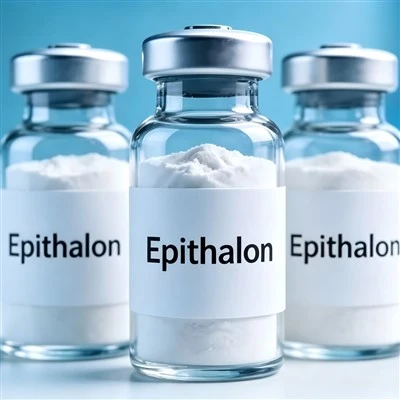
SynthPelys is a China-based manufacturer and supplier of Epitalon AEDG peptide (Epitalon, Epithalon, or AEDG peptide) for research use. Since 2010, we have supplied research peptides and related laboratory materials to more than 700 customers worldwide. Standard products may be available from stock. We also offer factory-direct pricing for small orders and OEM customization by agreement.
Product Overview
Epitalon AEDG peptide is a synthetic tetrapeptide with the amino acid sequence Ala-Glu-Asp-Gly (AEDG). Its CAS number is 307297-39-8, molecular formula is C14H22N4O9, and molecular weight is 390.35 g/mol. The sequence contains two acidic residues, glutamic acid and aspartic acid. Its polar structure gives the peptide good water solubility, making it suitable for aqueous experimental systems.
This product is research-grade peptide material intended only for in vitro cell studies and animal-model research. It must not be used for human injection, oral consumption, or clinical diagnosis or treatment. The research topics described here are based on publicly available literature and are provided for experimental planning only. They do not constitute medical advice or claims of efficacy.
Main Research Applications of Epitalon AEDG Peptide
The following areas reflect research directions reported in published literature. They are intended as references for study planning; the specific models, endpoints, and evaluation criteria must be determined by the research team.
Telomeres and Cellular Replicative Capacity
Telomere-related research is one of the most frequently discussed areas in the literature on Epitalon. Studies using cultured normal cells may examine telomere length, telomerase activity, hTERT mRNA expression, and changes in the number of cell passages to investigate mechanisms associated with cellular replicative capacity.
These studies may run over extended periods, making batch consistency important. For long-term projects, researchers may wish to secure material from the same batch at the outset and record the batch number and preparation date for each experimental run.
Circadian Rhythms and the Pineal–Melatonin Axis
Epitalon's research background is associated with pineal gland function. Research in this area may examine melatonin synthesis, cortisol secretion rhythms, and the expression of genes associated with the pineal gland.
Animal models are used in some studies. Any animal research must be conducted by qualified institutions in accordance with applicable local regulations and ethical requirements. This page does not provide dosage or administration protocols.
Oxidative Stress and Antioxidant Pathways
In oxidative-stress models, researchers may monitor reactive oxygen species (ROS), lipid peroxidation products, and the expression or activity of antioxidant enzymes such as superoxide dismutase and glutathione peroxidase. These measurements can be used to assess changes in redox status within the experimental system.
Epitalon is a highly water-soluble tetrapeptide with no hydrophobic amino acid residues in its sequence. Its solubility profile may be useful in cell-based studies that require controlled aqueous experimental conditions. Suitability should still be confirmed for the specific assay system.
Retinal Pigment Epithelial Cells and High-Glucose Injury Models
Some studies have used human retinal pigment epithelial cells cultured under high-glucose conditions to examine wound-healing behavior, epithelial-to-mesenchymal transition markers, and fibrosis-related indicators. These models are used to explore cellular mechanisms associated with diabetic complications.
Such experiments can be sensitive to culture conditions and control selection. Researchers should consider appropriate solvent controls and normal-glucose controls, while keeping sampling times consistent across experimental groups.
Reproductive Biology and In Vitro Embryo Culture
Published research has also examined Epitalon in in vitro systems involving oocyte maturation, embryo cryopreservation and recovery, and blastocyst hatching. Reported observation endpoints may include maturation rates, post-thaw embryo quality, and hatching outcomes.
These systems involve specialized ex vivo procedures and may require additional controls for material handling and solvent selection. Preparation and handling should take place under the conditions required by the relevant laboratory protocol.
Immunology and Thymus-Related Research
Some studies have focused on thymus-related indicators, immune-cell function, and interleukin-2 (IL-2) mRNA expression. These topics fall within basic immunological research.
Because immune-related experiments involve multiple variables, it is useful to define a primary endpoint before starting the study. This helps keep data interpretation manageable when several secondary indicators are also measured.

Epitalon AEDG Peptide Specifications
|
Item |
Specification |
|
Product Name |
Epitalon / Epithalon (AEDG Peptide) |
|
CAS Number |
307297-39-8 |
|
Amino Acid Sequence |
Ala-Glu-Asp-Gly (AEDG) |
|
Molecular Formula |
C14H22N4O9 |
|
Molecular Weight |
390.35 g/mol |
|
Appearance |
White to off-white lyophilized powder |
|
HPLC Purity |
≥99%, subject to the batch-specific COA |
|
Individual Impurity |
≤0.5%, subject to the batch-specific COA |
|
Solubility |
Soluble in water and commonly used aqueous buffer systems |
|
Packaging |
Sealed lyophilized powder in glass vials; custom packaging and OEM options available by agreement |
|
Available Documents |
COA, SDS (MSDS), HPLC chromatograms, and MS data, subject to batch availability |
|
Storage |
Store at −20°C in a sealed, dry, light-protected environment. After reconstitution, aliquot and store frozen in accordance with product documentation and the applicable research protocol. |
|
Shelf Life |
24 months for unopened lyophilized material, subject to the specified storage conditions and product documentation |
|
Intended Use |
Research Use Only (RUO) |
The specifications above are provided for product selection and identity checks. Actual purity and analytical results must be confirmed using the COA for the relevant batch.
Quality Assurance and Documentation
SynthPelys provides a batch-specific Certificate of Analysis (COA) that records the analytical method, chromatographic conditions, and test results. HPLC chromatograms and mass spectrometry (MS) data may also be supplied to support purity assessment and molecular identity checks.
The stated quality specifications are HPLC purity of ≥99% and an individual impurity level of ≤0.5%. Actual results are determined by the corresponding batch COA. Retained samples are kept for traceability and potential follow-up review.
Packaging and Shipping
Epitalon is packed as sealed lyophilized material in glass vials, with outer packaging designed to protect against moisture and impact.
The lyophilized powder may tolerate short periods of ambient-temperature transport, subject to the product's validated shipping conditions. Upon receipt, transfer it promptly to sealed storage at −20°C, protected from light and moisture, in accordance with the product documentation.
If the material is reconstituted for an authorized research procedure, aliquot it for the planned use and store it under the conditions specified for the material and experimental system. Avoid repeated freeze–thaw cycles.
FAQ
Q: What are the main research areas for Epitalon?
A: Research directions reported in the literature include telomeres and cellular replicative capacity, circadian rhythms and the pineal–melatonin axis, oxidative stress and antioxidant pathways, high-glucose injury models using retinal pigment epithelial cells, reproductive biology and in vitro embryo culture, and thymus- or immune-related studies.
Q: How do purchasing requirements differ between cell studies and animal-model research?
A: For cell studies, material requirements are usually estimated according to the number of experimental runs and replicate groups, so smaller pack sizes may be suitable during method development. Animal-model projects may run for longer periods and require material in concentrated purchasing cycles. Securing a consistent batch and planning the required quantity in advance can help reduce batch-related variation.
Q: How many observation endpoints should a study include?
A: A study should generally define one primary endpoint, with other measurements treated as secondary endpoints. Including too many endpoints can complicate data interpretation and make it harder to distinguish meaningful findings from experimental variation.
Q: Can concentration values from published papers be used directly?
A: Experimental systems differ in cell density, culture conditions, assay methods, and other variables. Conditions reported in the literature should not be assumed to transfer directly to another system. Researchers should evaluate suitability within their own validated experimental framework. This page does not provide concentration, dosage, or administration protocols.
Q: Which solvent should be used in experiments?
A: Epitalon is hydrophilic and may be prepared in sterile water or an appropriate aqueous buffer, depending on the experimental system. The solvent should be selected according to the study protocol, with a suitable solvent control included where needed.
Q: Why is a solvent control important?
A: The solvent, pH changes, and dilution procedures introduced during sample preparation may themselves affect cell behavior. A solvent control helps researchers distinguish effects associated with the test material from those caused by the preparation procedure.
Q: Can batch differences affect research results?
A: Even when materials are manufactured under consistent conditions, normal analytical and batch variation may occur. For long-running studies, researchers may consider purchasing sufficient material from one batch or retaining samples for cross-batch comparison.
Q: Can SynthPelys recommend a pack size for a particular research project?
A: SynthPelys can discuss pack-size options based on the planned project duration, expected consumption, and purchasing schedule. The final specification and quantity are subject to order confirmation.
Q: Can analytical documents be supplied for research records?
A: Batch-specific COAs, HPLC chromatograms, and MS data may be provided for laboratory records and material traceability. Additional analytical requirements should be discussed before placing an order.
Q: What is the difference between Epitalon and Epithalamin?
A: Epithalamin refers to a pineal gland extract and does not have a single CAS number corresponding to one defined chemical structure. Epitalon, also spelled Epithalon, is a synthetic tetrapeptide with the sequence Ala-Glu-Asp-Gly and CAS number 307297-39-8. Buyers should verify the CAS number and sequence rather than relying on the product name alone.
Research Use Only (RUO) Disclaimer
Epitalon (CAS 307297-39-8) is supplied as research-grade peptide material for in vitro cell studies and animal-model research. It must not be used for human injection, oral consumption, or clinical diagnosis or treatment. This product is not a medicine, is not sold or supplied as a drug, and is not affiliated with any approved marketed medicine.
The research topics and observation endpoints on this page provide background information for experimental planning only. They do not constitute medical advice or claims regarding efficacy or safety. Animal studies and work involving biological materials must be conducted by qualified institutions in accordance with applicable local laws, regulations, and ethical requirements. Researchers are responsible for complying with all requirements in their jurisdiction.

Why Choose SynthPelys as Your Epitalon Supplier?
Established supply experience:
More than 700 customers worldwide served with research peptides and laboratory materials since 2010.
Batch-specific quality information:
Stated purity of ≥99% and individual impurity of ≤0.5%, subject to confirmation by the batch COA.
Analytical documentation:
COA, HPLC chromatograms, and MS data available by batch, with retained samples supporting traceability.
Flexible order options:
Standard specifications may be available from stock, with small-order pricing and OEM customization by agreement.
Storage-conscious packaging:
Packaging designed to protect the material from moisture and light; storage at −20°C is recommended under the specified conditions.
Supply planning for longer projects:
Batch reservation and ongoing supply arrangements can be discussed according to the project schedule.



If you have any questions, please contact us:
For the latest wholesale pricing, sample requests, COA, SDS, and detailed technical information, please contact us.
Hot Tags: epitalon aedg peptide, China epitalon aedg peptide manufacturers, suppliers