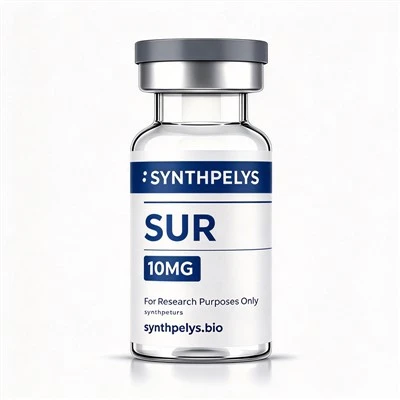
SynthPelys is a China-based supplier of research-use peptides and related laboratory materials. Established in 2010, we have served more than 700 customers worldwide. We offer in-stock products, factory-direct pricing for small orders, and OEM customization services, subject to order requirements.
What Is AOD-9604 10mg Peptide?
AOD-9604 is a synthetic peptide fragment derived from the C-terminal region of human growth hormone (HGH). It has been investigated primarily in research on fat metabolism and body fat regulation.
Unlike full-length HGH, AOD-9604 does not contain the complete growth hormone sequence. Researchers have studied its potential effects on lipolysis and lipid metabolism, as well as its biological activity in other experimental settings. Its effects and safety profile should not be assumed to match those of HGH or other metabolic peptides.
Manufacturing and Customization

SynthPelys supplies AOD-9604 research peptide materials with batch documentation and product specifications available for review.
Our services include:
- Flexible order quantities: Options for sample evaluation, small orders, and larger-volume procurement, subject to availability.
- OEM customization: Custom packaging and product requirements can be discussed and confirmed before ordering.
- Batch traceability: Product identification and available quality-control records support laboratory documentation.
- Quality documentation: COA, HPLC chromatograms, mass spectrometry (MS) reports, and SDS (MSDS) documents may be available, depending on the batch.
Purity, identity, and other product attributes should be assessed against the relevant batch-specific documentation.
How Does AOD-9604 Work?
AOD-9604 was developed to investigate biological activity associated with the fat-metabolism region of human growth hormone. Research has examined its possible role in lipid metabolism, including processes involved in the breakdown and storage of fat.
Areas investigated include:
- Lipolysis: Research into the breakdown of stored fat.
- Lipid metabolism: Investigation of pathways involved in fat storage and utilization.
- Glucose metabolism: Evaluation of whether AOD-9604 affects glucose regulation under specific experimental conditions.
- Cartilage and connective tissue: Preliminary research into possible biological effects in tissue-related models.
These are research areas rather than established clinical benefits. Claims about weight loss, blood glucose, insulin sensitivity, cartilage repair, or long-term weight management require appropriate evidence and should not be inferred from the peptide's proposed mechanism alone.
Key Research Characteristics of AOD-9604
- Studied for its potential role in fat metabolism and lipolysis.
- Investigated as a peptide fragment distinct from full-length human growth hormone.
- Examined in experimental models of lipid regulation.
- Evaluated for possible effects on glucose-related metabolic pathways.
- Studied in preliminary research involving cartilage and connective tissue.
- Offers researchers a defined peptide material for investigating specific biological questions.
These characteristics describe research interests, not proven therapeutic effects or guarantees of safety.
AOD-9604 Compared with Other Peptides
|
Feature |
AOD-9604 |
Human Growth Hormone (HGH) |
Semaglutide |
|
Material type |
Synthetic peptide fragment derived from HGH |
Full-length human growth hormone |
GLP-1 receptor agonist peptide |
|
Main research area |
Lipid metabolism and lipolysis |
Growth hormone signaling, growth, and metabolism |
GLP-1 signaling, appetite regulation, and glucose metabolism |
|
Biological pathway |
Investigated for effects associated with fat metabolism |
Growth hormone receptor signaling |
GLP-1 receptor signaling |
|
Glucose-related effects |
Requires assessment in the relevant experimental model |
Can affect glucose metabolism and insulin sensitivity |
Affects glucose regulation through GLP-1 receptor activity |
|
Safety considerations |
Human safety and efficacy are not established for general use |
Potential adverse effects depend on exposure and clinical context |
Known adverse effects include gastrointestinal symptoms in approved clinical settings |
|
Tissue-related research |
Preliminary investigations include cartilage-related models |
Studied in growth and tissue metabolism |
Not primarily developed for cartilage repair |
The three materials act through different biological pathways and are not interchangeable. Comparisons should be based on the research question, study model, and available evidence rather than assumed differences in safety or effectiveness.
Storage and Handling
Lyophilized material:
Store at −20°C when specified by the product documentation. Protect the vial from moisture and light, and keep it sealed as directed.
Material after reconstitution:
Storage temperature and permitted holding time depend on the formulation, solvent, container, and supporting stability data. Follow validated laboratory procedures rather than assuming a universal storage period.
Documentation:
Refer to the batch-specific label, COA, and applicable SDS for handling and storage requirements.
Research-use restriction:
This product is not intended for human or veterinary use and must not be used for diagnosis, treatment, or disease prevention.
Potential Adverse Effects and Safety Considerations
The safety profile of AOD-9604 has not been established for general human use. Possible effects cannot be reliably predicted from its proposed mechanism alone.
Headache, fatigue, and local irritation have been discussed in some contexts involving peptide use, but their frequency and causal relationship to AOD-9604 cannot be assumed without reliable supporting evidence. These observations should not be interpreted as a complete or validated adverse-effect profile.
AOD-9604 supplied by SynthPelys is intended for laboratory research only, not for human or veterinary administration.

Why Source AOD-9604 from SynthPelys?
Defined Product Specifications
Product identity, labeled content, and batch-specific quality information can be reviewed before procurement. Researchers should verify the applicable documentation for each lot.
01
Batch Traceability
Standardized documentation helps laboratories track the material used in individual experiments. Actual purity and identity should be confirmed using the corresponding analytical records.
02
Research Documentation
Available documents may include a Certificate of Analysis (COA), HPLC chromatograms, mass spectrometry (MS) reports, and SDS (MSDS) information, depending on the batch. These records support material review, laboratory filing, and procurement checks.
03
Flexible Purchasing Options
SynthPelys can discuss sample requests, small-volume orders, larger purchases, and ongoing supply arrangements, subject to stock availability and order confirmation.
04
Technical Information and Order Support
Our team can provide available product specifications, batch documentation, storage information, and general laboratory handling guidance. Experimental protocols and preparation conditions must be established by the research team in accordance with its own validated methods and institutional requirements.
05

Disclaimer
AOD-9604 powder is supplied for laboratory scientific research only. It is not approved by SynthPelys for clinical use and is not sold or supplied as a medicine. It must not be used in humans or animals for diagnosis, treatment, disease prevention, aesthetic procedures, or any other non-research purpose.
Purchasers are responsible for complying with all applicable laws and regulations governing importation, possession, handling, and research use in their jurisdictions.

If you have any questions, please contact us:
For the latest wholesale pricing, sample requests, COA, SDS, and detailed technical information, please contact us.
Hot Tags: aod-9604 10mg, China aod-9604 10mg manufacturers, suppliers