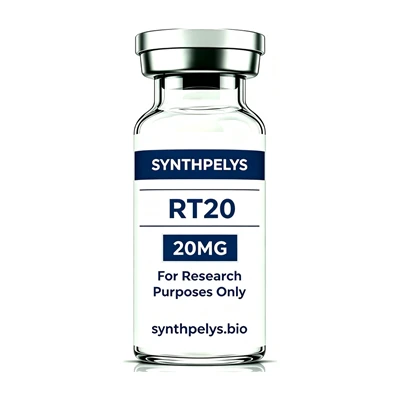
What Is MOTS-c?
SynthPelys is a professional MOTS-c (mitochondrial-derived peptide) manufacturer and supplier in China. Since 2010 we have supplied research peptide materials and supporting laboratory products to more than 700 customers worldwide. In addition to stock availability, we support factory pricing for small batches and provide OEM customization services.
MOTS-c stands for Mitochondrial Open Reading Frame of the 12S rRNA type-c. Its coding information sits within the mitochondrial genome - unlike the vast majority of peptides encoded by the nuclear genome - which is the basis for classifying it as a mitochondrial-derived peptide (MDP).
Main Research Directions for MOTS-c
The directions below are compiled from research angles reported in the public literature, offered only as topic and readout references for project design. The specific models, readouts, and criteria are determined by the researcher.
Mitochondrial function and mitochondria-to-nucleus signaling
This is the most fundamental line of work. Researchers typically observe changes in mitochondrial membrane potential, oxygen consumption rate, mitochondrial DNA copy number, and mitochondrial-related gene expression in cultured cells to describe mitochondrial functional state.
Other studies look at subcellular localization changes of this peptide under metabolic stress and how those changes relate to nuclear gene expression - work in the domain of mitochondria-to-nucleus signaling crosstalk.
AMPK-related pathways and cellular energy sensing
On the cellular energy-sensing line, the literature commonly uses phosphorylation levels of AMPK and related upstream/downstream proteins as readouts to examine how the pathway responds under different culture conditions.
Such experiments are sensitive to time-point settings. Define sampling time points at the protocol stage and run vehicle controls in parallel to separate material effects from handling effects.
Folate–methionine cycle and one-carbon metabolism
MOTS-c is frequently discussed alongside the folate–methionine cycle and one-carbon metabolism, with observation targets including intermediate metabolites such as AICAR and the expression of related metabolic enzymes.
These studies often pair with metabolomics and place high demands on sample preparation and sampling consistency; fix the sampling workflow and quenching method before the experiment begins.
Oxidative stress and stress adaptation
In oxidative damage models, antioxidant response element (ARE)-related gene expression, NRF2 pathway markers, and ROS levels are common readouts for describing cellular stress adaptation.
Because redox markers fluctuate considerably, these experiments usually need more biological replicates, and material consumption rises accordingly.
Skeletal muscle and metabolic tissue models
Skeletal muscle is among the most frequently reported tissue types. Studies often use skeletal muscle cell models to observe changes in glucose uptake, substrate oxidation markers, and metabolic enzyme expression.
Beyond skeletal muscle, readouts are also set in adipose, liver, and other metabolic tissue models to compare how different tissues respond to the same treatment condition.
Hepatic lipid metabolism and metabolite profiling
In liver-related models, readouts typically include lipid accumulation, acylcarnitine profiles, and changes in TCA cycle metabolites, used to describe the state of hepatic metabolic pathways.
These studies usually run on metabolomics platforms, with higher testing costs and sample requirements; plan purchasing over the entire project cycle.

Key Product Features
Distinctive origin, clear research entry point
Encoded by a short open reading frame in the mitochondrial genome, it is distinguishable by origin from nuclear-encoded peptides, suiting projects designed around mitochondrial function and cellular energy state.
Defined structure, verifiable on arrival
The 16-aa sequence, molecular formula, and molecular weight can all be verified by routine HPLC and MS methods; verification against the COA on arrival is straightforward, helping establish incoming material acceptance procedures.
Consistent batch metrics
Under standardized solid-phase synthesis and purification, purity, impurity profile, and peptide content stay within defined ranges across batches, suiting projects that require repeated verification.
Complete size ladder and documentation
Packaging exists for every size from 5 mg to 1 g, allowing a smooth transition from early verification to formal projects; each batch comes with a COA, MSDS, and testing spectra.
Mechanism of Action (Research Directions Reported in the Literature)
- Cellular energy-sensing pathways: phosphorylation of AMPK and related upstream/downstream proteins is a common readout;
- Folate–methionine cycle and one-carbon metabolism: intermediate metabolites such as AICAR and related metabolic enzyme expression serve as observation targets;
- Mitochondrial function: mitochondrial membrane potential, oxygen consumption rate, and mitochondrial DNA copy number are used as readouts;
- Subcellular localization and nuclear regulation: some studies focus on localization changes under metabolic stress and their impact on nuclear gene expression;
- Oxidative stress: ARE-related gene expression and NRF2 pathway markers are used as observation targets;
- All of the above are research directions and experimental readouts reported in the public literature; none constitutes any conclusion on efficacy, mechanism, or treatment.
Quality Assurance and Documentation
SynthPelys issues a COA per batch stating the test method, chromatographic conditions, and results, and can supply HPLC and MS spectra for structural verification. Quality targets are HPLC purity ≥99% and single impurity ≤0.5%; actual values follow the batch COA. Retention samples are kept for every batch for later traceability and cross-batch comparison.
Packaging and Shipping
The product is filled as lyophilized sealed vials with outer shock-proof and moisture-proof packaging. The lyophilized powder tolerates short-term ambient transport; transfer to −20 °C sealed, light-protected, dry storage promptly after arrival. After reconstitution, aliquot per single use and freeze, avoiding repeated freeze-thaw cycles.
MOTS-c Manufacturer and Supplier
As a MOTS-c manufacturer and supplier in China for CAS 1627580-64-6, SynthPelys provides the appropriate grade and documentation for research use:
- HPLC purity ≥99% with single impurity ≤0.5%, as stated on the batch COA;
- An independent COA per batch, stating test method, chromatographic conditions, and results;
- A complete size ladder from 5 mg to 1 g, allowing a smooth transition from early verification to formal projects;
- Lyophilized sealed vial filling with packaging designed for moisture and light protection;
- Samples, trial orders, bulk orders, and long-term supply supported, with batch locking available.
Research Use Only Statement (RUO)
MOTS-c (CAS 1627580-64-6) is a research-grade peptide material for in vitro cell studies and animal model research only. It must not be injected, taken orally, or used in clinical diagnosis or treatment in humans. This product is not a drug, is not sold or supplied as a drug, and is not associated with any marketed medicine.
Why Choose SynthPelys as Your MOTS-c Supplier?
Supplying research peptide materials and laboratory products to more than 700 customers worldwide since 2010;
Purity ≥99% with single impurity ≤0.5%, as stated on the batch COA;
COA and HPLC/MS spectra provided per batch, with retention samples for traceability;
A complete size ladder allowing a smooth transition from verification to formal projects;
Standard sizes in stock; factory pricing for small batches and OEM customization supported;
Lyophilized sealed vial filling with packaging designed for moisture and light protection.



If you have any questions, please contact us:
For the latest wholesale pricing, sample requests, COA, SDS, and detailed technical information, please contact us.
Hot Tags: mots-c peptide research, China mots-c peptide research manufacturers, suppliers